


Hello,
We all pay a hidden tax.
Not the kind your accountant files, the kind your confidence does.
It doesn’t show up on your payslip or your P&L.
But you feel it in every pause before you act, every decision you delay, every time you shrink a good idea down to safe.
It’s called the Confidence Tax, the quiet cost of self-doubt.
And it compounds faster than interest.
Because every hesitation doesn’t just lose time.
It leaks traction, focus, and conviction, the very things progress depends on.
The psychology of confidence explains why even the smartest people fall into this trap.
Confidence isn’t a personality trait. It’s a performance variable.
In behavioural psychology, self-doubt activates the brain’s error prediction system, the same circuitry designed to keep us safe from physical danger.
But in modern work, that safety mechanism backfires.
Instead of protecting you, it paralyses you.
You second-guess your choices, delay action, and seek more data to ease the discomfort of uncertainty.
Every pause feels small in isolation. But over time, those micro-hesitations stack up, missed opportunities, diluted ideas, and slower reactions.
That’s the real Confidence Tax: not one big failure, but thousands of micro-withdrawals from your self-trust account.
The highest performers don’t escape doubt. They just shorten the gap between hesitation and action.
They know confidence isn’t what you feel before you move. It’s what you earn by moving anyway.
That’s the Confidence Tax. Quiet, consistent, and costly.
Confidence doesn’t come from hype or affirmations. It comes from evidence.
Every action you take, even a small one, is a piece of evidence your brain records. It says, “I did that.”
That’s how self-trust is built, not in thoughts, but in repetitions.
Think of it as a loop:
Action → Evidence → Belief → Repeat
Each completed loop lowers the Confidence Tax. Each hesitation pays for it again.
Confidence isn’t built in thinking; it’s built in proving.
Most people wait to feel confident before they move.
The highest performers flip it. They move first, then let the action generate the evidence their belief needs to grow.
So when you catch yourself stalling, don’t wait for clarity. Shrink the action.
Do something small enough that your brain can’t argue with it: send the email, make the call, sketch the outline.
Momentum isn’t a mood. It’s a micro-move repeated until it feels natural.
A client I worked with, a senior leader in a fast-growing tech firm, once told me:
“I used to be decisive. Now, I second-guess everything.”
Her confidence hadn’t disappeared. It had been buried under too much input: data, opinions, and noise. Every decision went through ten revisions because she didn’t want to get it wrong.
Instead of rebuilding her confidence through reflection or reassurance, we focused on small, fast actions that created new evidence.
One decision per day, made quickly, documented, and reviewed weekly for outcomes, not emotions.
Within a month, something shifted.
The hesitation gap, the time between recognising a decision and acting on it, started to shrink.
By quarter’s end, she wasn’t overthinking strategy decks. She was leading them again.
That’s the quiet power of compounding self-trust: confidence rebuilt through proof, not pep talks.
Confidence didn’t come back as a feeling. It came back as a pattern.
That’s the shift, from emotion to evidence.
This week, test your own Self-Trust Loop with one micro-commitment a day.
Pick something small but specific, something your future self would thank you for.
Try this: ask yourself three questions at the end of each day.
1️⃣ Did I act before I felt ready?
Confidence grows through motion, not certainty.
2️⃣ What evidence did I just create?
Log every proof point. Small wins compound faster than you think.
3️⃣ Where did I hesitate, and why?
The pattern behind hesitation is the blueprint to rebuild trust.
Five days of this will show you exactly where your confidence leaks and how to close them.
Neuroscience backs it up.
Studies from the University of Illinois found that confidence doesn’t come from personality traits; it’s built through performance feedback loops.
Every time you take action and succeed, even in a small way, the brain releases dopamine, strengthening neural pathways tied to motivation and self-belief.
This is why performance coaches and elite teams track “decision velocity” as closely as output, because faster, evidence-based action is the real marker of confidence.
The opposite is also true.
Each time you hesitate or outsource your decision, those same pathways weaken. Over time, your brain learns to associate inaction with safety, and that’s when the Confidence Tax grows quietly in the background.
Confidence isn’t the absence of doubt; it’s the ability to act despite it.
Most people wait to feel certain before they move.
High performers move first, then let the evidence catch up.
Because confidence doesn’t come from affirmation.
It comes from accumulation, proof, progress, and the moments you acted anyway.7
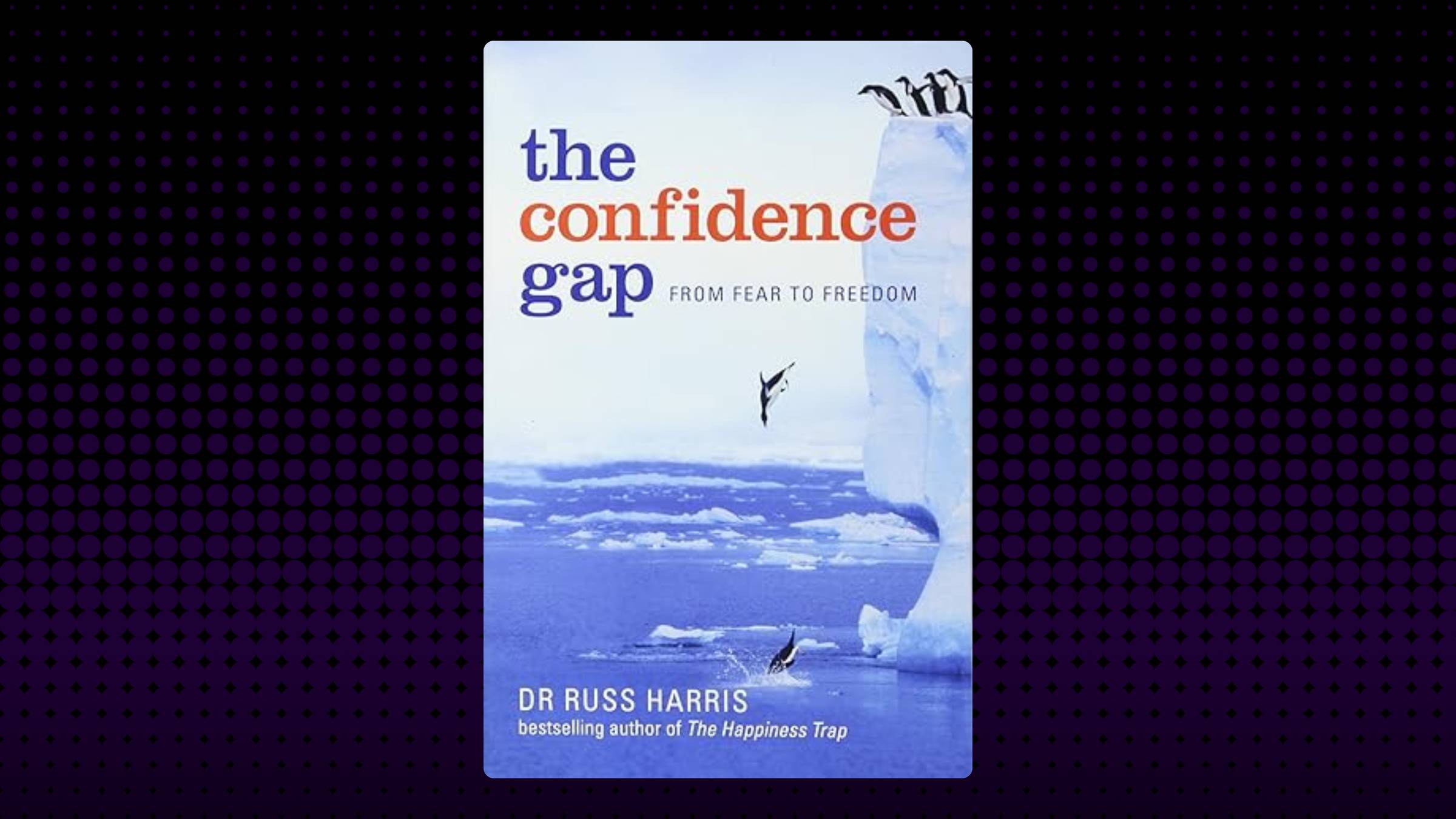
If self-doubt ever makes you hesitate, this is the book that breaks the spell.
Harris flips the idea of confidence on its head, showing that the most successful people aren’t the ones without fear; they’re the ones who take action alongside it.
It’s not about feeling ready. It’s about learning to move while your brain catches up.
I revisit this one often because it turns confidence from a mood into a method, and that’s exactly what kills the Confidence Tax for good.
If this issue hit home, download “Build Unstoppable Confidence.”
Inside, I break down practical, evidence-based strategies for building confidence as a skill, not a personality trait. These strategies range from reframing limiting beliefs to using micro-goals, keystone habits, and stress-management tools that keep momentum high when pressure builds.
Think of it as your companion to the Self-Trust Loop, a playbook to strengthen belief through action, one proof point at a time.
The Confidence Tax is paid in hesitation. The rebate is earned in action.
This week, run the Self-Trust Loop.
Pick one small decision you’ve been overthinking, and act.
Don’t wait for confidence. Let action be the trigger.
Each time you act, you earn proof.
Each time you hesitate, you pay tax.
The best performers aren’t fearless.
They’ve just learned to move while afraid.
Confidence isn’t built by eliminating fear. It’s built by proving you can move anyway.
Because confidence isn’t built in comfort, it’s built in motion.
Count how many decisions you delayed this week.
That number is your hidden tax bill.
To your unstoppable success,

Writer, The Success Method
P.S. What’s one area where self-doubt is quietly draining your confidence right now? Hit reply and tell me. I’ll share a few anonymous examples and how others broke the loop in a future issue.

%20(1).webp)
.jpg)


