


The biggest shift after you make it isn't in your bank account. It's in your head - and you don't have to wait to make it.

The day after my first real exit, I wasn't celebrating.
I was sitting in a hotel room feeling like a total fraud. Waiting for a feeling that never came.
The money had changed. I hadn't.
I was still running the same programme I'd run when I had nothing. Save to survive. Protect what you have. Brace for the thing that takes it away.
The scarcity didn't leave when the bank balance grew. It just had a bigger number to worry about.
There's a name for this.
Identity lag.
The circumstances change faster than the belief system.
Athletes who retire. Lottery winners. Founders who exit. We all hit it. The external world shifts. The internal narrative takes far longer to catch up; if it ever does without deliberate work.
Mullainathan and Shafir spent years studying this. Their finding wasn't just that scarcity causes stress - it was that scarcity actively shrinks your cognitive bandwidth. The mental load of not having enough occupies so much processing power that everything else suffers.
They called it the bandwidth tax.
The bandwidth reduction under scarcity reduced performance on intelligence measures by nearly a full standard deviation. Significant cognitive impairment - caused not by who you are, but by how scarce you feel.

The mechanism is what they called tunnelling.
Scarcity forces the mind to narrow onto the immediate shortage. You become laser-focused on what you lack, and everything outside that tunnel gets dropped. Busy people mismanage their time for exactly the same reason people in debt mismanage their money. Same trap, different resource.
Here's the uncomfortable truth for founders: the survival programme isn't a character flaw. It isn't weakness or lack of ambition. It's a measurable cognitive state that was neurologically reinforced over years of genuine uncertainty.
Mullainathan and Shafir were clear on this:
"The problem isn't the person. It's the programme they're running."
Which is why the exit doesn't fix it on its own. The bank balance changes. The bandwidth tax doesn't lift automatically. That takes a different kind of work.
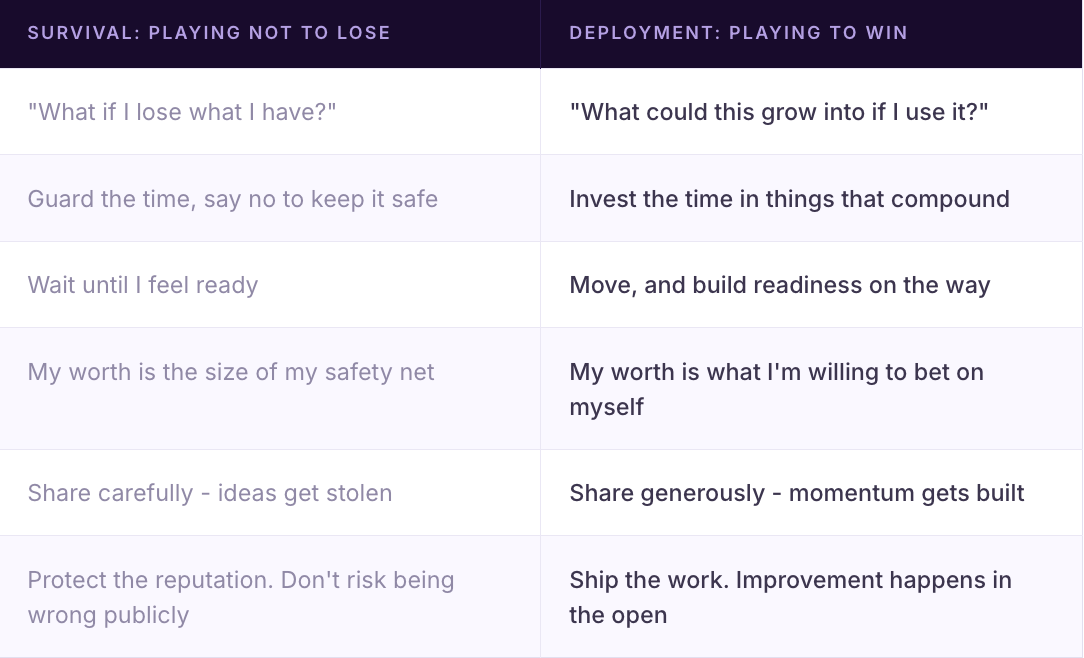
The deployment mind doesn't wait for certainty. It moves, and builds readiness on the way.
Here's what matters: the switch isn't triggered by an exit, a number, or a milestone.
I was proof.
The money came.
The mindset didn't follow without work.
The switch is a decision. You can make it today.
Saving every pound and never investing it guarantees you stay where you are.
Same is true of your time, your courage, your self-belief. Hoarded, they don't keep you safe. They slowly lose value while you wait for permission to use them.
Deploying isn't reckless. It's the deliberate act of betting your resources on your own growth instead of guarding them against an imagined disaster.
Every small bet you make on your own future is a rep. You're not waiting to feel abundant. You're building the evidence that you are
THE SWITCH
You don't make this shift once and never look back.
It's a practice. The survival programme runs deep, put there by years of genuine uncertainty. It doesn't dissolve because you decided it should. It needs to be caught, named, and replaced. Deliberately. One thought at a time.
This week: catch yourself in one survival thought.
Write the deployment version next to it. Then act on the right one, once.
Survival vs Deployment: The Map
This Week's Deployment Practice
Name one resource you've been hoarding: time, money, a conversation you've been avoiding, a bet on yourself you've been deferring.
Then deploy it. Not everything. Just one thing.
The goal is building a consistent track record of trusting your own future.
I’ve been there.
I built the exit I wanted and spent the first week waiting for permission to enjoy it.
The permission never comes from outside. It was always the decision.
Make it today.
To your unstoppable success,


%20(1).webp)

.jpg)


