


Saying yes to the wrong things is quietly bankrupting you, and it is not just about money.

Most people are terrified of taking the hit.
Walking away from money on the table, ending the relationship, disappointing the person in front of them. So they over-please.
They stay nice. And being nice slowly bankrupts them.
Because there is absolutely such a thing as bad revenue.
The client who constantly moves the goalposts. The commitment that drains you. The relationship that costs you far more in energy and self-respect than it ever returns. It looks like a gain on paper. It’s a loss everywhere that matters.
Loss aversion: the well-documented tendency to feel losses more acutely than gains - makes saying no feel like losing something real.
Saying yes preserves the illusion of safety in the short term.
But your brain is optimising for the wrong timeframe. It’s protecting you from a paper cut while letting you bleed out slowly.
It poisons the whole well.
In a business, a single toxic client doesn’t just cost you that account.
It poisons the culture, exhausts your best people, and quietly lowers everyone’s standards for what’s acceptable.
And your best people don’t complain.
They leave.
“Nice that costs you your peace isn’t kindness.
It’s self-betrayal wearing a polite face.”
In life, it’s the same.
One draining relationship, one obligation you resent, one yes you should have made a no, and it bleeds into everything.
Your mood.
Your sleep.
The energy you have left for the people who actually deserve it.
The invisible bleed is the cruelest part, because you can’t see exactly where you’re losing it.
You tell yourself you’re coping. And you are, but coping is not thriving. And the things that would let you thrive are getting whatever’s left over.
Bad revenue doesn’t just cost you now.
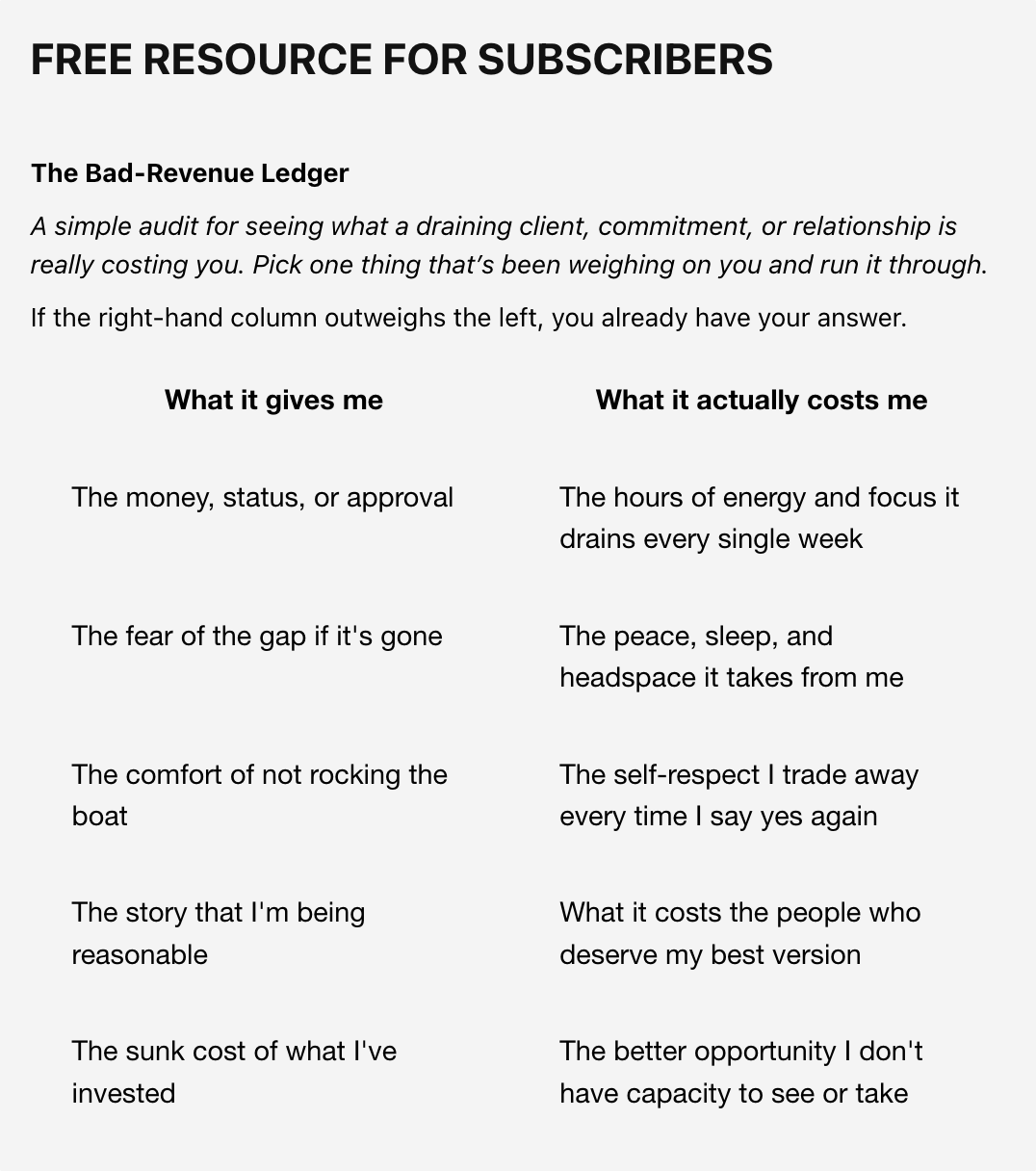
Most people calculate the cost of a bad client or commitment in isolation: the time it takes, the energy it drains, the money it brings in. That calculation almost always makes staying look reasonable.
But bad revenue has a compound cost that never appears on that ledger. It costs you the better client you didn’t have capacity for.
The creative project you didn’t have energy for.
The standard you quietly lowered to accommodate the wrong person.
Every month you hold onto bad revenue, you’re not just paying the direct cost. You’re paying the opportunity cost of everything it displaced.
The most expensive thought in business and in life is
‘We’ve already invested so much.’
The sunk cost is gone regardless, you can’t recover it.
The only question is what the next hour, the next month, the next year costs you.
Staying to recover what’s already lost guarantees you lose more.
The uncomfortable moment that sets you free...
Firing bad revenue; a client, a commitment, sometimes a relationship, always stings in the moment. Trust me, I've been there.
There’s a real, immediate cost, and your brain screams about it.
The gap.
The awkwardness.
The fear that nothing better will come.
But that short-term sacrifice pays back a thousand times over.
You free up the space, the energy, and the self-respect that the right things need to grow.
Every founder who’s ever let go of a toxic client says the same thing: within weeks, something better arrived, because there was finally room for it.
“The hit is temporary.
Freedom isn’t.”
Protecting the morale of your own life, your peace, your standards, the people who lift you: is the priority.
Everything good is built on top of that.
Everything.
The question isn’t whether to let it go.
It’s how much longer you’ll pay for it before you do.
To owning your time,

Writer, The Success Method

%20(1).webp)

.jpg)


