


Stop pretending. Hustle culture sold you a lie. Your best work hides inside about three real hours.

Let me say the quiet thing out loud. The 14-hour grind you see glorified online is mostly theatre. The truth, backed by how human focus actually works, is that most people get around three genuinely productive hours out of an eight-hour day. The rest is motion dressed up as progress.
Anders Ericsson, whose decades of research produced the concept of deliberate practice, found that elite performers, musicians, athletes, surgeons, chess grandmasters, couldn’t sustain more than about four hours of genuinely high-quality work per day.
Not because they lacked commitment. Because that’s the physiological ceiling. After that, you’re not working. You’re basically cosplaying.
So the people winning aren’t the ones grinding longest. They’re the ones who protect those three hours like they’re made of gold, and stop apologising for the rest.
THE BUSYNESS IDENTITY TRAP
Many people don’t just work long hours; they’ve made long hours part of who they are. When productivity becomes identity, stopping feels like shrinking. The person who’s always busy gets admired. The person who’s done at 1pm gets suspicion. But the question isn’t how long you worked. It’s what moved.
Think of a car with the engine screaming in neutral. Loud, hot, burning fuel, going nowhere. That’s a 14-hour day spent reacting to everything and choosing nothing. You end it exhausted and convinced you worked hard because you did. Hard is not the problem. Aimless is.
“Three hours of clear, chosen work beats fourteen hours of performance.”
Burnout rarely comes from doing too much that matters. It comes from doing too much that doesn’t, for too long, while telling yourself the volume is the point. The thing that breaks people isn’t intensity. It’s sustained meaninglessness.
There’s also a cognitive cost that accumulates invisibly. Every reactive email, every half-attended meeting, every decision you didn’t need to make depletes the same resource pool as your deepest thinking. Your brain runs on glucose and it doesn’t distinguish between a budget review and a pointless reply-all. You can’t spend it on everything and still have it for anything.
Stop fixing the floor. Start fuelling the ceiling.
In business, the move is to hand the things you shouldn’t be doing to people who are better at them, so you’re freed to do the few things only you can. The same logic runs in your personal life. What are you clinging to out of guilt, pride, or habit, that someone else could do, or that doesn’t need doing at all?
Your energy is your single most finite resource. Right now you’re probably spending your sharpest hours on your smallest tasks. The floor gets fixed. The ceiling stays exactly where it is. And the gap between where you are and where you could be quietly widens.
THE -ONLY-YOU QUESTION
What are the three things in your work and life that only you can do? Not things you’re good at; things where you are genuinely the best or only option. Those get your peak hours. Everything else is negotiable. If your list has more than three, it’s not a list of priorities. It’s a list of habits.
Recovery is infrastructure, not idleness
If three hours are gold, what should happen in the rest? This is where most people get it wrong. They feel guilty for not working at full intensity, so they half-work, scrolling, half-reading, staying vaguely available - and they get neither the recovery nor the output.
Rest isn’t the enemy of performance. It’s the mechanism. Sleep, movement, genuine disconnection - these aren’t breaks from the work. They’re the restoration that makes the three hours possible again tomorrow, and the day after, and the year after.
The most disciplined thing you can do isn’t to fill every hour. It’s to protect the hours that actually matter - and let the rest genuinely restore you.
Where are your three best hours going today?
If you don’t know, that’s the first thing worth changing.
The Three-Hour Rule
A one-page system for spending your sharpest hours on what actually moves your life.
Step 1. Find your peak window
For three days, note the two-to-three-hour stretch where you feel most clear and focused. For most people it’s mid-morning, before the inbox has filled and the day has fragmented. That window is your gold.
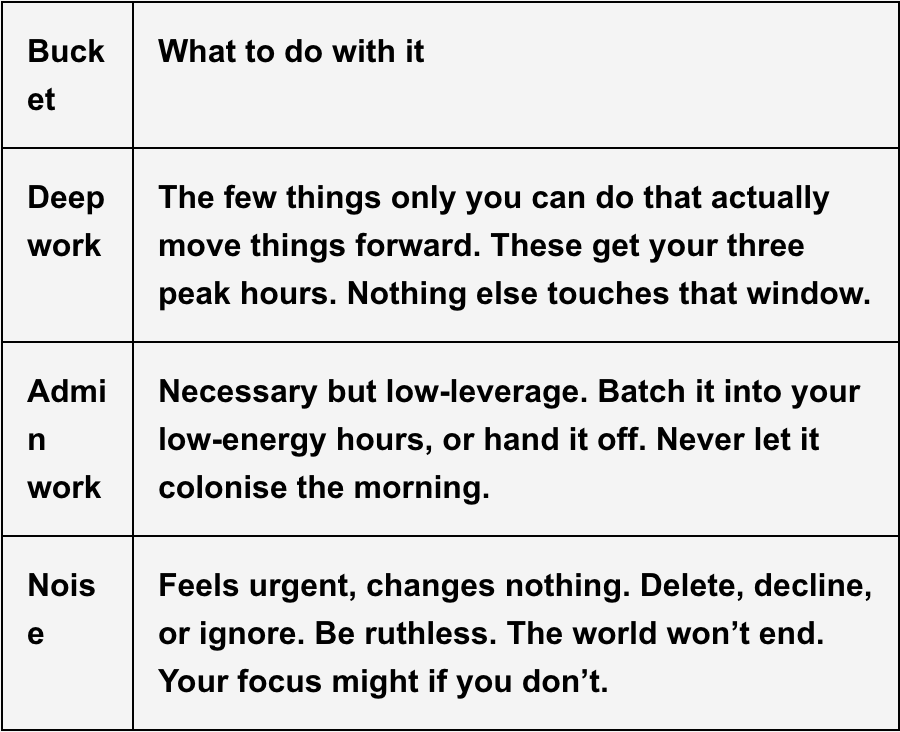
Step 2. Sort every task into one bucket
Step 3. Defend the window
No meetings, no inbox, no ‘quick things’ in your peak hours. Protect them like the most important appointment you have. Because they are. Everything else waits. If it can’t wait, it’s not the window that’s the problem, it’s the system around it.
To your unstoppable success,

Writer, The Success Method

%20(1).webp)

.jpg)


