


Why knowing where your strengths end is one of the most important parts of scaling.
Experience hasn't made me brilliant at everything, if anything it's made me more aware of what I'm not brilliant at. Three exits in, I can tell you exactly where my edge is, and exactly where it stops. That took me longer to admit than it should have.
Early on, admitting I wasn't always the strongest person in the room felt like admitting I didn't deserve to be in it. That's just the ego wearing a founder's hat. Most founders think knowing your weaknesses is a confession of some kind or that its something you hide from investors, clients and the rest of your team.
I believe it's the opposite.
You should treat your weaknesses like a map for where best to manage. If you listen to them and really sit with them, they tell you exactly where someone else needs to start.
I've watched this play out with founder after founder I've coached, and I’ve lived it myself before I could coach anyone on it. The ones still doing everything themselves tend to be the ones who never sat down and named their weaknesses properly.
Most likely because their identity was still tangled up in trying to be the answer to everything!
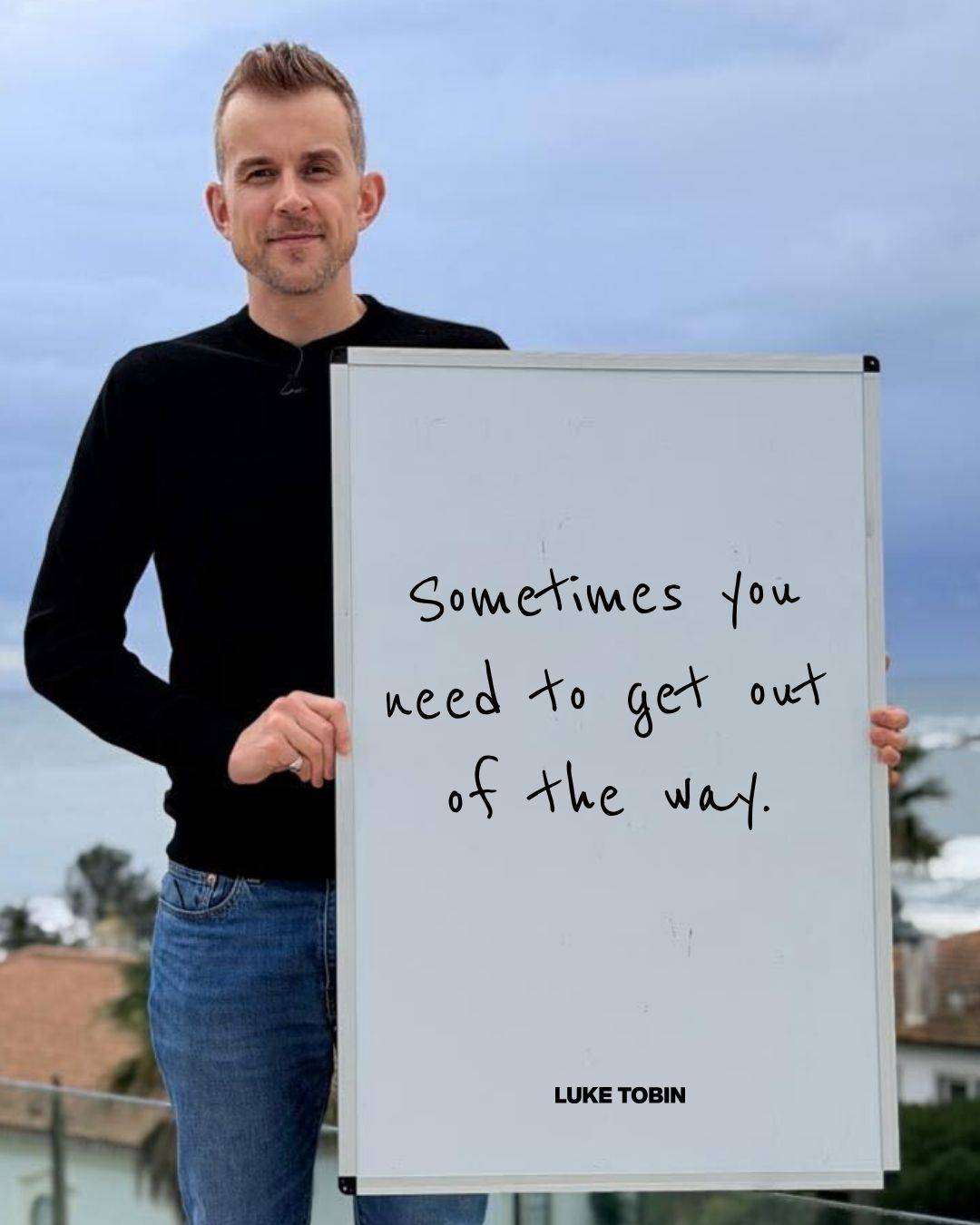
I’m not necessarily talking about delegation here. I think this is more of an identity problem.
1. Name it and own it
“I’m not great with numbers” isn’t self-awareness, it's still your identity masking its weakness with uncertainty. Real self-awareness is specific, for example: I make good calls on positioning and product. I make bad calls on cash flow forecasting and hiring for finance.
Vague weaknesses stay yours forever, because nobody can act on them. Specific weaknesses become like a brief that you can hand to someone else. Give it a name and move it along for someone else to carry.
2. Let your gaps pick the team
Insecure founders hire people who need them whereas confident founders hire people who cover exactly what they don't.
If everyone on your team is waiting for you to have the answer then instead of a company you’ve just built a more expensive version of yourself, that requires extra steps.
Your job is to know precisely what you're not best at, and go find who is. That takes a founder mindset most people never develop: measuring your worth by what you build and not by what you can do.
3. Accept the 90% rule
Here's the excuse every control freak tells themselves: "Nobody can do this as well as me."
You know what? That might be true. Maybe. But lets look at the numbers here and see if that’s even a good thing.
Ten tasks done by you at 100% is a hard ceiling. Ten tasks handed to someone who's strong in that area, done at 90%, buys you back the hours to go work in the lane best suited to you.
That 10% gap is what it costs to stop being the only one with the answers..

Psychologists call it a fixed mindset; the belief that ability is static, that if you're not already good at something, you never will be.
Carol Dweck's research offers a simple antidote: add the word "yet." You're not bad at delegating, you just haven't learned how to delegate yet. You're not bad at letting go, you just haven't learned the muscle of letting go yet.
I believe everyone has weaknesses but it's how you treat and manage those weaknesses that are important.
If you're at the point where you know the business is too dependent on you, this is the kind of work I do through my Business Advisory; helping founders move from overworked operator to exit-ready CEO. It's hands-on strategic advisory built to remove your bottlenecks, install scale-ready systems, and unlock revenue you can't see while you're still the one doing everything.
I've also worked with more than 200 founders through Agency Coaching, helping them build high-profit agencies without burning out. It's private, founder-focused coaching that helps you master leverage, and lead with clarity, using the same frameworks I've used to scale and exit.
I want you to take ten minutes of your day, that’s it, and I want you to list your last ten decisions. Next to each one, ask: did this need me, or did it just default to me?
Circle the ones that defaulted to you and use that list as a starting point in your delegation roadmap.
Pick one of the tasks, hand it off to someone else this week and let it land at 90%.
Most founders think stepping back means caring less and I believe in the opposite.
Stepping back is what lets the business survive contact with reality so you can survive a bad quarter, a sick week, an exit without you propping up every load-bearing wall personally.
I didn't fully believe that until I sold my first business and watched it run for a week without a single message from me. Seeing that the business and how it didn’t fall apart told me more about what I'd built than the sale price did.
You do not need to be brilliant at everything. Stop trying to be the only answer and start building the thing that requires more.
Here's to knowing exactly where you stop, and letting someone else start,
One more thing: I'm writing my first book on the thing most founders never say out loud, self-doubt, and how the ones who win actually work with it instead of hiding it. Join the waitlist here to get early access when it's ready: Waitlist

Writer, The Success Method

%20(1).webp)

.jpg)


